
You have, then, leapt. Enrolling in a lifeguard certification program signals the start of a difficult, fulfilling, and extremely accountable path. Often, the evening before your first day combines thrilled anxiety and nervous expectation. What will it truly be like? Will you literally and figuratively be hurled into the deep end? Knowing what to anticipate helps you arrive ready, confident, and prepared to take it all by storm.
Your first day of lifeguard training is a special combination of administrative preparation, introductory fundamental knowledge, and your first actual taste of the physical challenges of the vocation. It’s the day you change from someone who wants to be a lifeguard to someone really studying to become one.
Registration and the Weight of Responsibility: The Morning Buzz
Most of you will start your day in a classroom or poolside environment rather than in the water. The first hour or so is spent on the basic but less glamorous aspects of the process: registration and documents. You’ll be checking your requirements, including proof of age (usually 15 or more for most fundamental certificates) and signing any appropriate waivers.
The course director or head instructor establishes the tone for the whole program here as well. They will greet you and instantly position the course as the basis for a vital public safety part rather than just a battery of examinations to pass. You are here to acquire knowledge of how to avoid disasters and, if need be, to preserve lives.
Beyond the Whistle: Introduction to Lifeguarding Principles
Real learning starts once the administrative duties are finished. The lifeguard’s responsibilities are usually covered first in the first classroom session. This is far more than simply watching the water. You will be introduced to the idea of surveillance and learn how to methodically scan your assigned area of protection. It’s about cultivating a protector’s gaze: an active, attentive, constant scan that misses nothing.
You will talk about a lifeguard’s responsibilities, which cover facility maintenance, rule enforcement, and customer service in addition to rescuing. Furthermore, explored in this part are the legal aspects of the job, including the standard of care and the results of carelessness. Though depressing, it is an essential aspect of the instruction, highlighting the intensity of the lifeguard certification you are striving for.
Another important subject brought up on day one is the EMS system, which is the chain of survival beginning with the instant you identify a victim in need, awaiting the arrival of sophisticated medical assistance. In that chain, you are the first and most important link.
Assessing Your Swimming Proficiency: The First Fitness Test
It’s time to go to the pool and transform following the classroom theory. Many candidates both loathe and look forward to this moment: the preliminary swimming abilities test. Although it is not the last exam, this gatekeeper guarantees all candidates possess the basic aquatic ability necessary to securely continue with the more sophisticated rescue training.
Though demanding, the prerequisites are usual. Using a mix of front crawl—often 300 yards—and breaststroke, you will have to swim a continuous length. The main thing here is not speed but rather sustained, powerful form and stamina. Usually at a depth of seven to ten feet. This mimics the recuperation of a passive victim.
Read More: The Lifeguard Shortage Crisis: Why Pools Are Closing and What Facilities Can Do
For even experienced swimmers, this first swim test can be humbling. Performing on day one in different surroundings among new people can put pressure on you that might impact your performance. Instructors are searching for drive and expertise and are aware of this. Should you battle, they usually offer comments and might let you retest. A major self-esteem boost comes from passing this test, which officially qualifies you for the upcoming rescue skills.
Acquiring Equipment: A Beginning to Rescue Gear
Having finished the swim test, your first day mostly comprises a hands-on introduction to the tools of the trade. You will show the fundamental tools you will become familiar with throughout the course. Among them are:
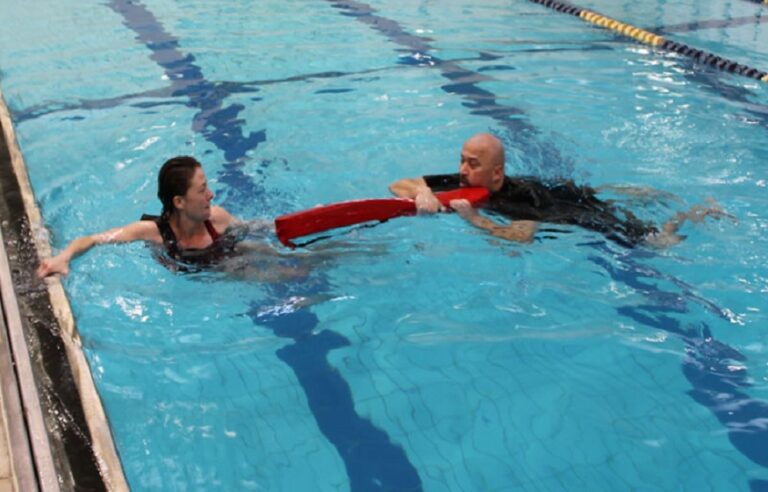
- Your major rescue equipment will be the rescue tube. You will discover the many ways you may employ it for assistance and pulling, as well as how to approach a victim with it and how to correctly wear it.
- Applied in the treatment of spinal damage, the backboard will be introduced to you together with its parts and function in in-water extrications.
- You will get your first look at the tools utilized for delivering breaths during CPR—a basic element of your future training—Pocket Masks and Bag Valve Masks (BVMs).
Dealing with this gear gives the training a real aspect. It brings the ideas from the theoretical pages of a book into your hands, enabling you to picture the situations when you will have to rapidly and successfully utilize them.
Handling Day One: The Mental and Physical Toll
You will be physically exhausted from the swimming as you stow your damp gear and head home, but more significantly, you will be intellectually satiated. Designed to completely immerse you in the world of lifeguarding, day one is an information dump. Natural responses are a little overwhelmed. The physical strain of the swim test helps to clarify the knowledge that this lifeguard certification is not a casual hobby, together with the obligations defined in the classroom.
Read More: What Is American Lifeguard Training & How to Get Certified
Consider the day. Hydrate, eat a good meal, and rest. Building directly on these foundations will be the days that follow. You’ll delve more deeply into rescue procedures, train CPR on manikins, and run through unending simulations. Like other high-calibre groups, the American Lifeguard Association arranges its curriculum to progressively build ability and muscle memory so that by the close of the course, your reactions get nearly intuitive.
Your first day of lifeguard training is a little of the whole trip: it’s hard, instructive, and goal-oriented. You have started the process. You have encountered the physical standard, grasped the importance of the role, and grabbed the devices that could someday save a life. Embracing both the weariness and the intellectual excitement. Arrive on day two with the same dedication and focus, and you will be well on your way toward obtaining that desired lifeguard certification alongside those committed to water safety.
About the Author